A friend of mine once downloaded Duolingo to learn Russian, a language he had always loved from a distance, the way you love something that intimidates you. Russian felt too serious, too difficult to commit to. So he made it a game.
I did the same with Arabic.
Arabic had always lived in that same category in my mind: beautiful, complex, almost unreachable. If I treated it lightly, I thought, perhaps I could test whether I truly loved it. Perhaps the app would tell me if I was capable.
Time passed. I learned nothing. Or at least, nothing that stayed.
I assumed the problem was Arabic. So I chose Dutch: softer, closer and more reasonable. I used Duolingo consistently for a year. Every day. I reached a 365-day streak. And the day I completed it, I quit.
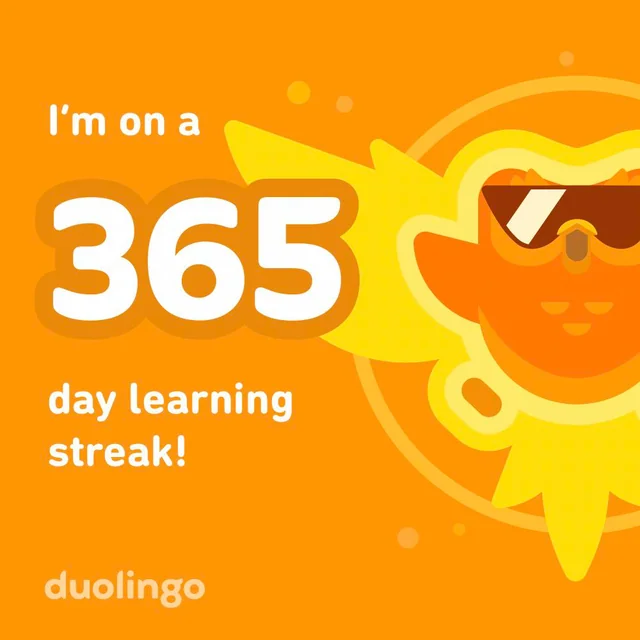
Because after one year, I still could not introduce myself without the phone in my hand.
I could get every exercise right inside the app. Perfect scores. Golden trophies. But if you asked me to repeat a simple sentence without looking, I froze. I could recognize everything. I could produce nothing.
That was the moment I understood: it wasn’t the language. It was the system.
I later tried Memrise. It felt different, faster. Within days you can greet someone, ask basic questions. It gives you the illusion of immediacy. But with the free version, vocabulary blocks are limited. And I realized something uncomfortable: even if I unlocked every block, I would still not be speaking. I would still be collecting words the way you collect stamps, neatly, passively, uselessly.
I will write a separate article sharing my full opinion on Duolingo, Memrise, and other language learning apps. This one is about something deeper.
Why apps don’t make you fluent. And what does.
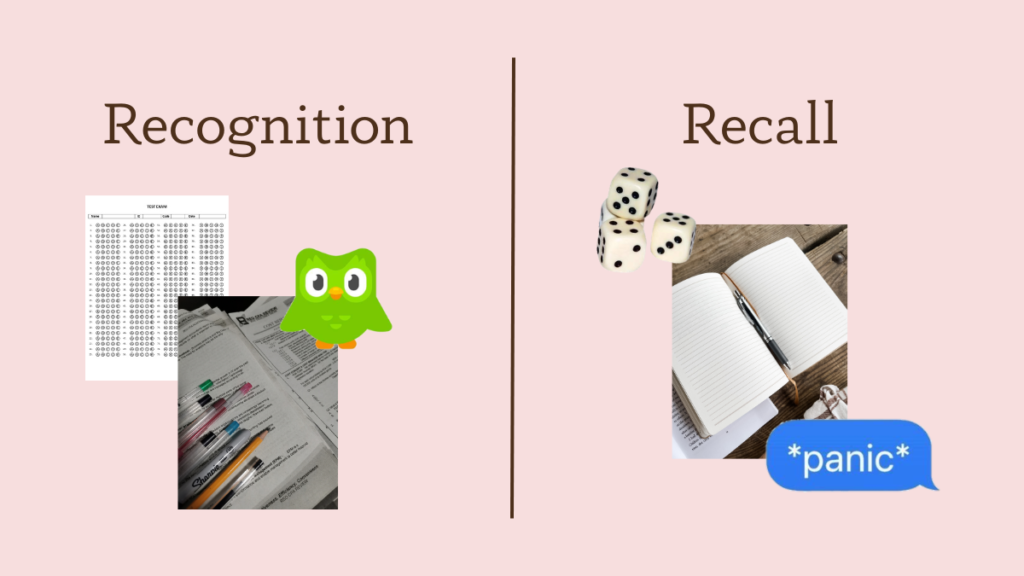
Recognition vs recall: why you understand everything but can’t speak
The most painful discovery in my language journey was this distinction:
- Recognition is seeing a word and knowing what it means.
- Recall is producing that word from nothing.
Language apps are masters of recognition.
You see the sentence. You match it. You reorder it. You fill in a blank. Your brain feels competent because the answer is there, somewhere on the screen. It is guided.
But fluency requires recall.
When I tried to speak Dutch without my phone, there was no word bank. No multiple choice. Just silence.
Cognitive science has been clear about this for decades: retrieval strengthens memory. This is known as active recall, the effort of pulling information from your mind without cues. It feels harder because it is harder. And that difficulty is precisely what makes learning durable.
Recognition feels smooth. Recall feels humiliating.
Only one builds fluency.
Gamification vs competence: the illusion of progress in language learning apps
Gamified systems are not evil. In fact, research shows that gamification can increase motivation and consistency, especially at the beginning. Streaks, points, badges: they create momentum.
And momentum matters.
The problem begins when motivation replaces competence.
For months, my 365-day streak felt like proof of discipline. I was proud of it. I defended it. Losing it would have felt like failure.
But the streak was measuring one thing: daily app usage.
Not speaking ability. Not comprehension of native content. Not real communication.
Gamification can initiate a habit. It cannot replace meaningful practice.
And meaningful practice is uncomfortable. It involves hesitation, mistakes, correction, embarrassment.
No confetti animation rewards that.
How I reached C1 in English (and why it was different)
I did not reach C1 in English because of an app.
I have been studying English in academies since I was seven. Years of structured learning. But structure alone was not enough either. What maintained and elevated my English was immersion.
I read in English.
I listen to podcasts.
I write in English.
I speak whenever I can.
English stopped being a subject and became an environment.
That is the difference.
An app can simulate a classroom exercise. It cannot simulate a life lived partially in another language.
Why inmersion works: what science says about input and spaced repetition
With French, I stopped studying in the traditional sense. No grammar books. No vocabulary lists.
Instead, I chose immersion. Podcasts. Films. French politics. French cinema. Culture.
I believe languages are not certifications. They are doors into other worlds. If you don’t care about the world behind the language, you will eventually quit.
From a scientific perspective, this makes sense. The brain retains information better when it is emotionally and contextually meaningful. Input that connects to identity and curiosity is far more powerful than isolated drills.
Spaced repetition (reviewing information over increasing intervals) is also supported by research. Many apps use this principle well. But repetition without context produces fragile knowledge.
Spaced repetition plus real exposure creates depth.
That is where fluency grows.
My 3-pillar system for becoming fluent in a language
After my frustration with Dutch apps and my experience with English and French, I realized something simple.
Fluency requires three pillars:
1. Massive Input
Reading, listening, watching. Not textbook sentences, real content. Even if you understand only 60% at first.
2. Output (Even When It’s Ugly)
Speaking before you feel ready. Writing imperfectly. I struggle with this in French. I understand much more than I can say. That gap only closes through practice. Platforms like italki have helped me when I actually commit to using them.
3. Feedback
Correction from someone who knows better than you. Otherwise, mistakes fossilize.
Apps rarely provide real feedback. They provide right or wrong. Real feedback explains why.

Why I no longer rely on apps alone
I am disciplined. I like structure. But I also get bored. I get disappointed by slow progress like anyone else.
Apps promise acceleration. They promise efficiency. They promise that five minutes a day is enough.
It isn’t.
Languages unfold slowly. They demand patience. They reward immersion. They require that you tolerate sounding foolish.
I am learning to enjoy that slowness.
Each podcast episode in French is a small victory. Each new word understood in context is a quiet expansion. I no longer measure progress in streaks. I measure it in comprehension.
I measure it in the moment I realize I am thinking in another language.
Final thoughts
Language learning apps are not useless. They can start you. They can motivate you. They can make the first contact less frightening. But they cannot carry you to fluency.
Fluency is built in silence, in repetition without prompts, in conversations where you hesitate and try again. It is built in cultural curiosity. In immersion. In recall, not recognition.
I once believed that if I reached a 365-day streak, I would become someone who spoke Dutch. Now I know better. Fluency is not a streak. It is a life lived slowly in another language.