There was a time when my room during exam season looked like a small, silent catastrophe. Clothes on the chair, the bed unmade, empty energy drink cans on my desk like proof of devotion. I would spend the whole afternoon in the library, convinced I was studying, only to come home at night and realize I had absorbed almost nothing. So I would sit again. Midnight. Two a.m. Three.
I never failed an exam. But I never became who I could have been either.
This article is not a moral lesson against laziness. It is about something much more uncomfortable: the way we confuse effort with learning. And how neuroscience quietly proves that the method most of us use, cramming, works against the very brain we are trying to train.
What is spaced repetition? The science os learning and how memory actually works
Spaced practice, also called the spacing effect, is the principle that we retain information better when we review it over increasing intervals of time instead of repeating it all at once.
This idea is not new. In 1885, Hermann Ebbinghaus published experiments on memory showing that forgetting follows a predictable curve. We lose information rapidly after learning it unless we revisit it strategically. His famous “forgetting curve” demonstrated that timing matters as much as effort.
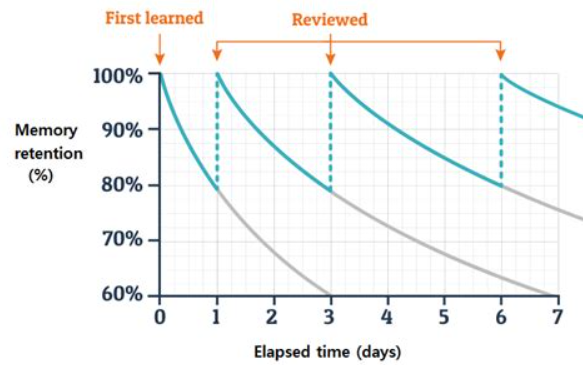
More than a century later, cognitive psychology confirmed what he observed. A landmark review by Henry L. Roediger III and Jeffrey D. Karpicke (2006) showed that retrieval practice, actively trying to recall information, dramatically improves long-term retention compared to passive rereading. Later research by John Dunlosky (2013) ranked spaced practice and practice testing among the most effective study strategies supported by evidence.
But beyond names and dates, there is something more intimate happening in the brain.
When we revisit information after a delay, the hippocampus, the structure deeply involved in memory consolidation, has to work harder to reconstruct the memory trace. That effort strengthens synaptic connections through processes like long-term potentiation. In simple words: difficulty builds durability.
Cramming feels efficient because the memory is fresh. Spaced practice feels harder because you are allowing yourself to almost forget and then pulling the information back. That small struggle is the point.
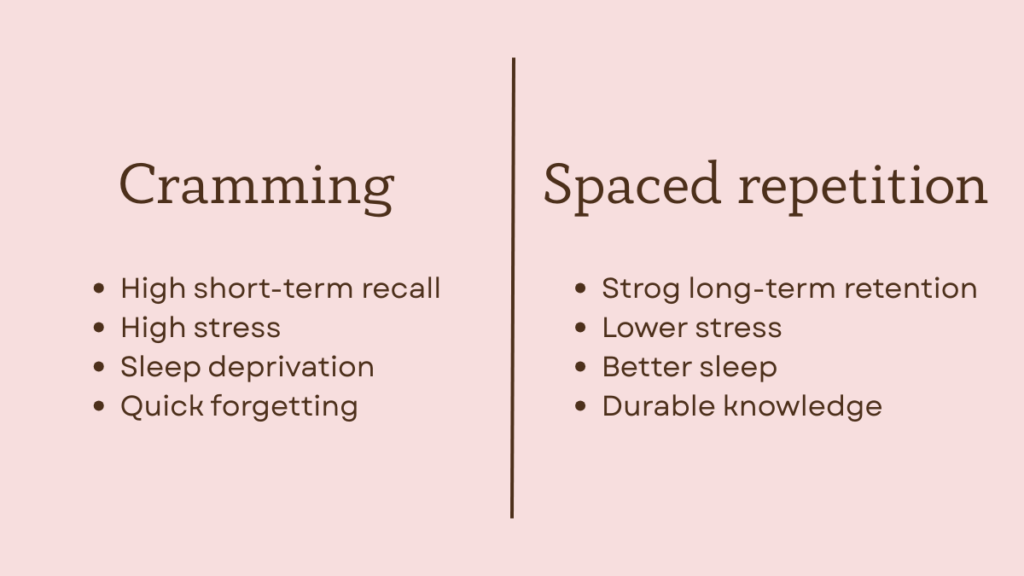
Cramming vs spaced repetition: short-term performance vs long-term retention
In my last year of high school, I lived inside a cycle that looked productive from the outside. Library all afternoon. Desk all night. Coffee instead of dinner. Sleep as an inconvenience.
The day before the exam, I would finally force everything into my head. And yes, I passed. But a few days later, it was gone. “Exam passed, exam forgotten.” Always thinking about the next one. Never building anything lasting.
Research consistently shows this difference:
- Cramming improves short-term performance.
- Spaced repetition improves long-term retention and transfer of knowledge.
Studies in educational psychology demonstrate that massed practice (cramming) can produce high immediate recall, but spaced study produces significantly better results on delayed tests, even when total study time is the same.
What hurts most is this: I was exhausted for results that were temporary.
I would sit in class the morning after a night of studying until 3 a.m., fighting sleep, feeling small and incapable. Not because I wasn’t intelligent but because my method was incompatible with how memory works.
How I discovered spaced repetition (and why I almost ignored it)
When I entered university to study chemistry, I knew something had to change. Memorizing three months of content in two nights was simply not realistic anymore.
At first, I didn’t aim for excellence. I aimed for survival.
I started by doing something embarrassingly simple: I paid attention in class. I stayed awake. I took notes I could understand later. That alone reduced the panic before exams.
Around that time, I began watching videos about evidence-based study methods. I had heard of spaced repetition before, but it seemed too complex, something hyper-disciplined students did with color-coded systems and perfect planners.
Then I learned the science behind it. It wasn’t about aesthetic organization. It was about biology.
So I tried.
How to use spaced repetition when you don’t have much time
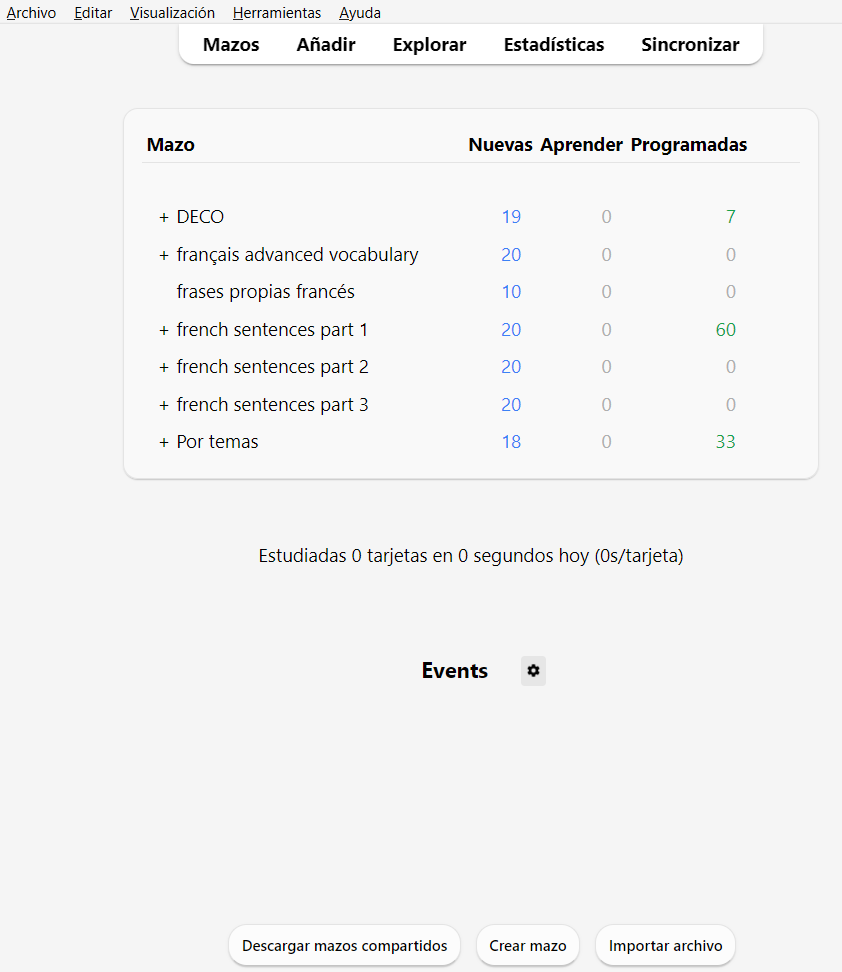
The tool that removed the barrier for me was Anki.
What I love about it is simple: it decides the spacing for you. You do not need to calculate intervals. You only need to answer honestly whether you knew the card or not.
In my first year of university, I used Anki to prepare biology. The difference was not dramatic in appearance, I still studied, but internally, everything changed.
I no longer sat in front of a text rereading paragraphs until they blurred. I retrieved. I failed. I corrected. I moved on.
And it does not require endless hours. Thirty to forty minutes of daily review is enough.
I combine spaced repetition with active recall in larger sessions, forcing myself to explain mechanisms out loud or connect concepts. The flashcards give me precision and active recall gives me structure.
Now I use it for French vocabulary as well. The feeling is different. When I close my laptop, I know I learned something. Not just visited it.
If you are overwhelmed, start small:
- Create 15–20 flashcards per lecture.
- Review daily for 30 minutes.
- Trust the algorithm.
- Accept that slight forgetting is part of the process.
If Anki feels too technical at the beginning, platforms like Quizlet offer a softer entry point with a more visual interface.
And remember that consistency beats intensity very single time.
Why so many students study for hours and still feel like they’re failing
I see it constantly: girls studying all day, exhausted, yet feeling incapable. They mistake duration for depth.
When results don’t match effort, something dangerous happens: they begin to doubt themselves.
Burnout. Frustration. Procrastination born from quiet shame.
Spaced practice does something subtle but powerful: it gives you proof of progress. Each correct retrieval is evidence. Evidence builds confidence. Confidence reduces stress. And reduced stress improves learning.
It becomes a virtuous cycle instead of the vicious one I lived in.
Final thoughts
I sometimes think about that girl in her messy room, studying until three in the morning, convinced exhaustion was a sign of ambition.
She was not lazy. She was misinformed.
Neuroscience does not reward suffering. It rewards timing, retrieval, and rest.
Spaced practice is not glamorous. It does not feel heroic. But it builds something cramming never gave me: calm competence.
And perhaps that is what we are really searching for, not just passing exams, but becoming someone who learns in a way that lasts.