There is a scene in The Bell Jar where the fig tree appears: each fig a different life, each life desirable, and the girl starving beneath them because she cannot choose. I read that image years after I had already been living it.
My problem with concentration did not begin with social media. It began the moment I understood that life is short (offensively short) and that no matter how disciplined I became, I would never have time to live all the lives I wanted.
I study Chemistry at university. I am building what I hope will become a serious professional career. I study French. I am learning to drive. I teach Spanish. I exercise. I write two articles a week here. I create content for Pinterest. I try to have a social life that feels alive and not merely scheduled.
From the outside, I look disciplined. From the inside, I often feel fragmented.
And that fragmentation is what no one talks about when we speak about “focus problems” in high-achieving students.
You are not distracted. You are hyper-ambitious without a system.

The real reason high-achieving students struggle with focus
My lack of concentration has often been mistaken, even by myself, for procrastination.
Sometimes it was. When a task felt too difficult, or when I didn’t know how to approach it, I avoided it. That is ordinary.
But the moments that hurt the most were different. I would sit down to study, and my mind would already be running ahead:
- What is the next task?
- How will I manage all of this when I have even more responsibilities?
- Am I choosing the right path?
- Does this subject deserve my time?
I wasn’t scrolling. I wasn’t being lazy. I was thinking excessively.
I live too often in the future. Meditation has helped. I keep Insight Timer on my phone, and when I feel overwhelmed by the sheer quantity of lives I want to live, I sit down and breathe. Sometimes that is all I can do: return to the present for five minutes.
But the deeper issue is structural. Ambition, when unmanaged, fractures attention.
Dopamine, multitasking and the illusion of productivity
A few months ago, I deleted Instagram. I removed the easiest dopamine trigger from my environment.
What surprised me was this: my focus did not magically improve. Because my dopamine did not depend only on social media. It depended on planning.
Researching new goals.
Designing new systems.
Imagining future milestones.
Reorganizing my week for the third time.
Planning gives a dangerous illusion: once it is organized, it feels half done.
Neurologically, this makes sense. Anticipation itself releases dopamine. The brain rewards the expectation of achievement almost as much as achievement itself. Each new plan becomes a small emotional high.
But there is a cost.
In cognitive psychology, researchers describe something called attention residue. When you switch from Task A to Task B, part of your attention remains stuck on Task A. It does not disappear immediately. It lingers.
If you study chemistry for twenty minutes, then check your language goals, then adjust your weekly calendar, then return to chemistry, you are not returning with full cognitive capacity. You are returning divided.
Related to this is the task switching cost: every time we shift tasks, the brain must reconfigure its mental settings. This reconfiguration consumes time and cognitive energy. Even small switches accumulate into measurable performance loss.
When I tried to do everything at once (chemistry problem sets, article ideas, future career planning) I felt busy. I felt ambitious.
I was also inefficient. Not because I lacked discipline. But because I was fragmenting my own cognition.
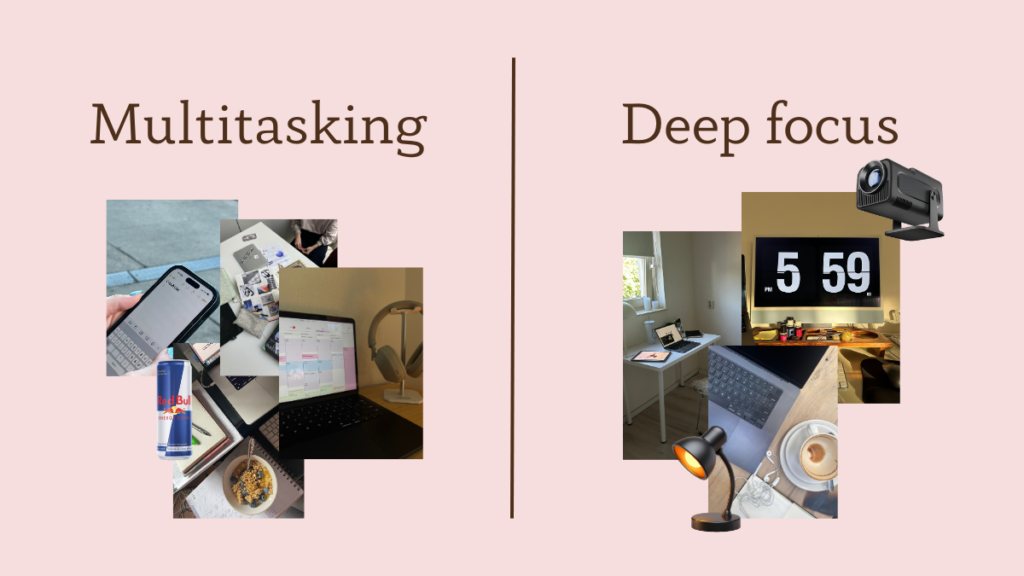
Ambition fragmentation: living in the future instead of the present
The most difficult part of being ambitious is not working hard. It is deciding that what you are doing right now is enough.
There are days when I feel overwhelmed not because I am lazy, but because I want to extract every drop from this one life. Not in a purely productive sense but existentially. I want to experience it fully. I want to build something meaningful. I want to deserve the time I’ve been given.
And yet, the paradox is brutal: When you constantly think about the next milestone, you dilute the one in front of you.
It becomes hard to finish something without mentally moving on to the next thing. It becomes hard to be convinced that what you are studying today truly matters.
That doubt alone can destroy focus.
Deep work, morning silence and training my brain to stay
In another article, I wrote about my experience reading Deep Work and what changed for me afterward.
The most important shift was simple: I began working in focused blocks.
One or two hours. Preferably in the morning. Complete silence. One task that actually matters.
No phone.
No extra notes.
Nothing on my desk that does not belong to that task.
It sounds obvious. It was not easy.
At the beginning, even forty minutes felt unbearable. I had to train myself to sit with my thoughts without escaping. Some days I managed thirty minutes. Some days less.
But over time, something changed. The sessions became more natural. And more importantly, more effective.
Scientifically, this aligns with what we know about attentional control. Sustained focus is not a personality trait, it is a trained cognitive state. The brain strengthens what it repeats. Long, uninterrupted blocks reduce task switching cost and allow attention residue to fade instead of accumulate.
The key was not perfect discipline. It was reducing fragmentation.

Why organizing your life for hours is not the solution
This is the part I wish someone had told me earlier: Spending hours organizing your life is not productive.
It feels responsible. It feels intelligent. It feels strategic.
But unless that organization translates into protected, distraction-free execution, it is decoration.
The best system is not the most complex one.
It is the one that takes minutes to maintain and protects hours of real work.
Now, my planning is minimal. A few minutes daily. A short weekly reset. Nothing more.
The rest of the time is reserved for doing.
Because the truth is uncomfortable: No system will save you from the discomfort of depth.
You still have to sit down and think.
You are not distracted. You are overextended
If you are a high-achieving student who struggles with focus, it may not be because you lack discipline.
It may be because:
- You are thinking about too many futures at once.
- You confuse planning with progress.
- You switch tasks before attention has fully settled.
- You doubt whether your current effort deserves your limited life.
I have felt all of that. I still do, sometimes.
But I no longer interpret it as a character flaw. It is unmanaged ambition. And ambition, without structure, will scatter you.
Final thoughts
There is nothing wrong with wanting many lives.
There is nothing wrong with being aware of how little time we have.
But depth requires a temporary renunciation of all the other figs on the tree.
When I sit down in the morning now, I try to make a quiet agreement with myself:
For the next hour, this is the only life that exists.
Not the future CEO.
Not the polyglot.
Not the version of me managing ten responsibilities effortlessly.
Just a girl in front of a difficult problem, choosing to stay.
And most days, that is enough.